EMT Practice Test

1. Question Content...


Question List

Question1: What are IOPS?

Question2: Consider the following vSAN host configuration:
Each host contains one vSAN disk group

All drives in the vSAN disk group are attached to the same storage controller

All virtual machines are assigned the Virtual SAN Default Storage Policy, which has not been modified

ESXi is installed on and running from a drive connected connected to a separate storage controller

vSphere HA is enabled

What happens when the storage controller with the vSAN drives attached fails?

Question3: The following are configuration details for a 10-node hybrid vSAN cluster:
Each node has 7 x 2 TB magnetic disks, 1 x 800 GB SSD.

What is the raw capacity of this cluster as configured?

Question4: An administrator has configured a storage policy with a Primary level of failures to tolerate set to 3 and assigned this policy to a virtual disk.
What is the minimum number of hosts required in this vSAN cluster?

Question5: What is the purpose of the cache tier in an all-flash vSAN cluster?

Question6: Which statement is true regarding vSAN and vSphere high availability (HA) interoperability?

Question7: An administrator is designing a new vSphere cluster with vSAN enabled that will span four racks with multiple hosts per rack. The requirement is to provide recoverability during a rack outage.
What needs to be done to meet this requirement?

Question8: What is the maximum supported latency between the preferred and secondary sites in a vSAN stretched cluster configuration?

Question9: Consider the following scenario in a vSAN cluster that contains six hosts:
All virtual machines are assigned the vSAN Default Storage Policy, which has not been modified.

Deduplication and compression are not enabled.

Every vSAN disk group in the cluster contains one cache device and five capacity devices

What happens when a capacity devices transmits SCSI sense code errors and fails?

Question10: With the addition of local protection to vSAN stretched clusters, which factors determine the maximum level of object protection?

Question11: vSAN storage policies can be created from which three of the listed vSAN rules? (Choose three.)

Question12: A virtual machine named VM01 is running on Host01 on a four-node vSAN cluster. vSphere HA is enabled for the cluster. vSphere HA host isolation response is set to Power off and restart VMs. VM01 has a storage policy assigned to it that contains the rule Primary level of failures to tolerate = 1.
A network failure occurs that causes a vSAN network partition. Host01 is isolated from the rest of the cluster. The other three nodes are NOT affected by the network failure.
How does this network failure impact VM01?

Question13: What is storage latency?

Question14: Which two statements are true about VSAN deduplication and compression? (Choose two.)

Question15: What are two ways that storage policies can be applied? (Choose two.)

Question16: An administrator is designing a vSAN cluster for a number of new workloads. The design calls for the use of erasure coding with RAID 5.
Which statement is true about what is needed to meet the needs of this scenario?

Question17: Which three objects that belong to virtual machines are contained in a vSAN datastore? (Choose three.)

Question18: In a vSAN stretched cluster with Primary level to tolerate set to 1 and Secondary level of failure to tolerate set to 2, what is the maximum amount of space that a 100GB virtual disk could consume without any other policy rules set?

Question19: An administrator is designing a vSphere cluster with the VSAN default policy. The requirement is to maintain full redundancy of data and virtual disks during any patching or maintenance of this cluster.
What is needed to meet the needs of this scenario?

Question20: Which two factors affect storage performance? (Choose two.)

Question21: Which two statements are true about the vSAN health and performance services? (Choose two.)

Question22: Which are two functions of software checksums in a vSAN environment? (Choose two.)

Question23: Storage policies can be based on which two types of rules? (Choose two.)

Question24: Which two VM Storage Policy rules are supported with vSAN iSCSI Target LUNs? (Choose two.)

Question25: Which of the listed configurations is a valid and supported vSAN configuration?

Question26: Which statement is true about the deduplication and compression feature in vSAN?

Question27: Which three virtual machine file types are contained in a VM home namespace object in a vSAN cluster?
(Choose three.)

Question28: vSAN supports Microsoft Windows Server Failover Cluster (WSFC) with which configuration?

Question29: Which three of the listed items are monitored by the vSAN performance service? (Choose three.)

Question30: A three-host hybrid vSAN has been deployed. Hardware maintenance is required for one of the hosts.
What happens when the host is place into maintenance mode using the "Evacuate all data" option?

Question31: What is the VMware-recommended network configuration between the three sites in a vSAN stretched cluster?

Question32: An eight-node vSAN cluster has been deployed. vSAN fault domains are NOT configured. A virtual machine with a 100GB virtual disk (VMDK) is created on the cluster. The 100GB virtual disk is assigned a storage policy with the following rules:
Primary level of failures to tolerate = 1

Failure tolerance method = RAID-1 (Mirroring) - Performance

Which statement is true about how vSAN places the component(s) that make up this object?

Question33: For which scenario is network multicast required?

Question34: Which three of the listed categories appear in the vSAN Health user interface? (Choose three.)

Question35: Which key is required to unencrypt an encrypted core dump when using vSAN encryption?

Question36: If a vSAN capacity device experiences a pattern of sustained high latency, how does vSAN attempt to remediate the issue?

Question37: A cache tier device experiences a permanent disk failure.
Which of the below represents a valid process for replacing the failed disk?

Question38: Given a limited maximum queue depth, what can an administrator do to potentially improve performance when deploying vSAN iSCSI volumes?

Question39: Which of the listed three vSAN features provide space efficiency? (Choose three.)

Question40: The following are configuration details for a three-node vSAN cluster:
Each host has two disk groups and each disk group has 7x1.2TB 10K SAS drives.

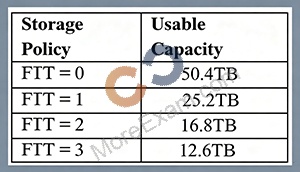
Each host has 16.8TB of raw capacity and the three-node cluster has 50.4TB of raw capacity.

Deduplication and compression are not enabled.

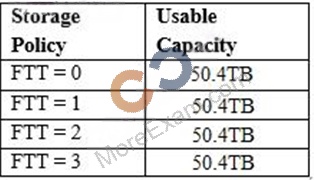
Based on the following FTT Values in the storage policy, what is the total usable capacity?

A:

B: Cannot be calculated until vSAN datastore is online.
C:

D:

Question41: Which two are vSAN networking best practices? (Choose two.)

Question42: Which vSAN health check category is viewed to confirm supported storage controller drivers are in use across all hosts in the cluster?

Question43: How does vSAN respond when a vSAN drive is pulled from a server chassis or a host if a vSAN cluster fails without warning?

Question44: View the exhibit.
The exhibit shows a single node of a vSAN cluster. All nodes have been configured identically.
Which statement is true about the information in the exhibit?

Question45: Which statement the describes vSAN architecture?

Question46: What is required for enabling deduplication and compression in a vSAN cluster?

Question47: Which are two characteristics of a RAID-1 storage configuration? (Choose two.)

Question48: Which replication solution is supported with vSAN and Site Recovery Manager?

Question49: When using RAID-5 with a 100GB virtual disk, what is the maximum capacity consumed on the vSAN datastore for this virtual disk?

Question50: Which two statements are true regarding storage policies? (Choose two.)

Question51: In order to support Oracle Real Application Cluster (RAC), which change must be made to each applicable virtual machine?

Question52: When using vSAN in a two-node direct connect configuration, how do data nodes communicate with the vSAN witness appliance?

Question53: A six-node all-flash vSAN cluster has been deployed. Deduplication and compression are enabled. All virtual machines are produced by policies with the rule Primary level of failures to tolerate set to 1.
How is a vSAN disk group impacted when the cache device belonging to that disk group fails?

Question54: If the Primary level of failures to tolerate policy is changed from 2 to 3 without shutting down the virtual machine, what will happen when the policy is applied?

Question55: A 12-node vSAN cluster has been deployed across three server racks in a data center.
There are four nodes in each server rack.

A vSAN fault domain has been configured for each server rack for a total of three fault domains.

All virtual machines in the cluster have the vSAN default storage policy assigned to them.

This policy has not been modified.

vSphere HA is enabled for the cluster.

One of the server racks loses power.

How does this affect virtual machines running on this cluster?

Question56: What happens when a healthy capacity tier disk is pulled from one of the ESXi hosts in a vSAN cluster?

Question57: For a hybrid vSAN configuration, the SSD resides in which tier?

Question58: What is the Storage-Based Management framework primarily used for?